What we build,
and what it solves for you
Legalcomplex builds and runs its own products for legal intelligence. The design and engineering behind them are available to your team. Our principles are to build token-efficient, supply chain-secure solutions.
Products
Each one links straight at the running thing, not at a page about it.
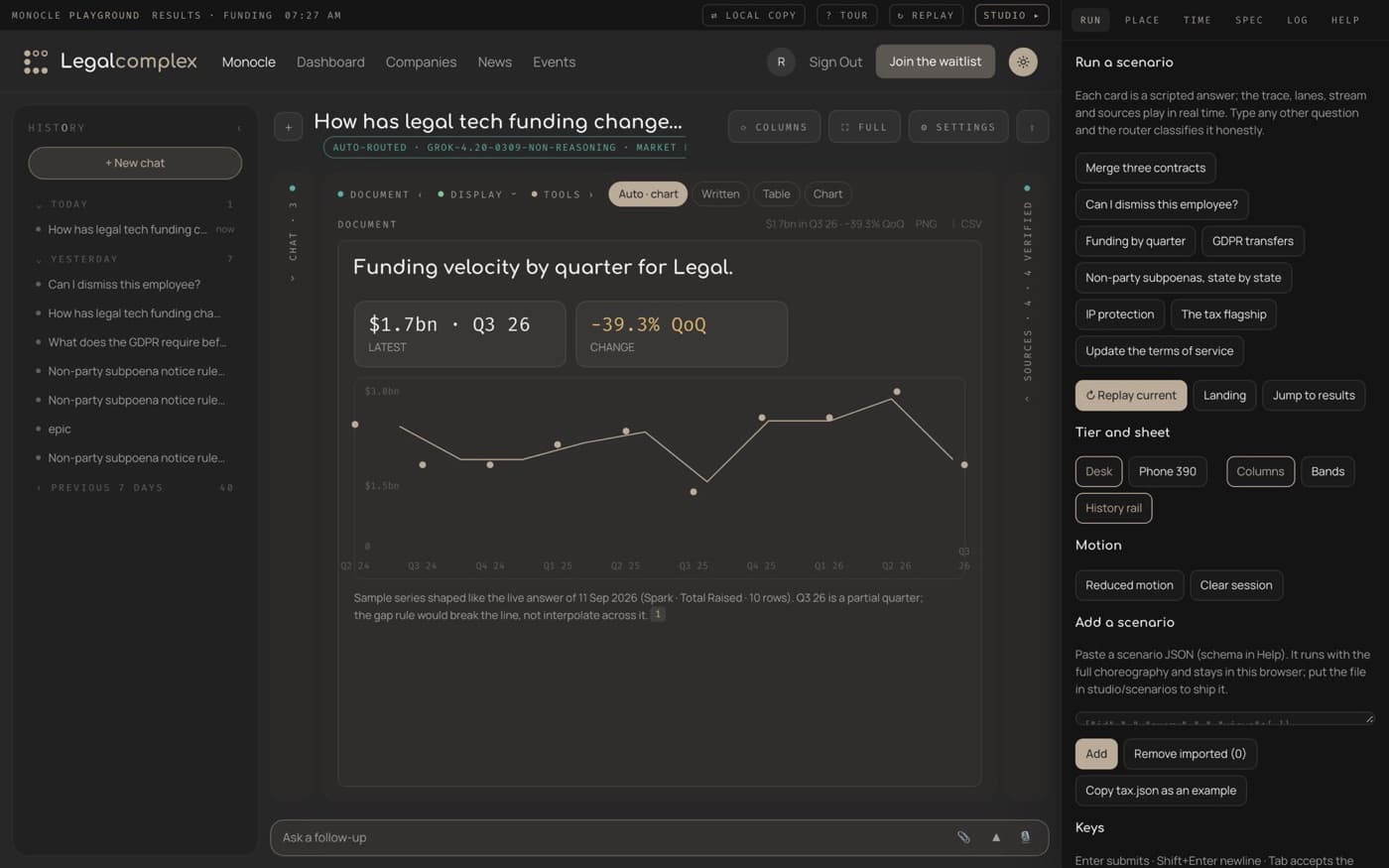
Monocle
Invited pilotA research workspace that shapes a grounded answer into whatever display: 19 of them, from a table to a timeline to a map.
So you can see what the AI actually found, check it at the source, and hand it to someone else on any device without rebuilding it.
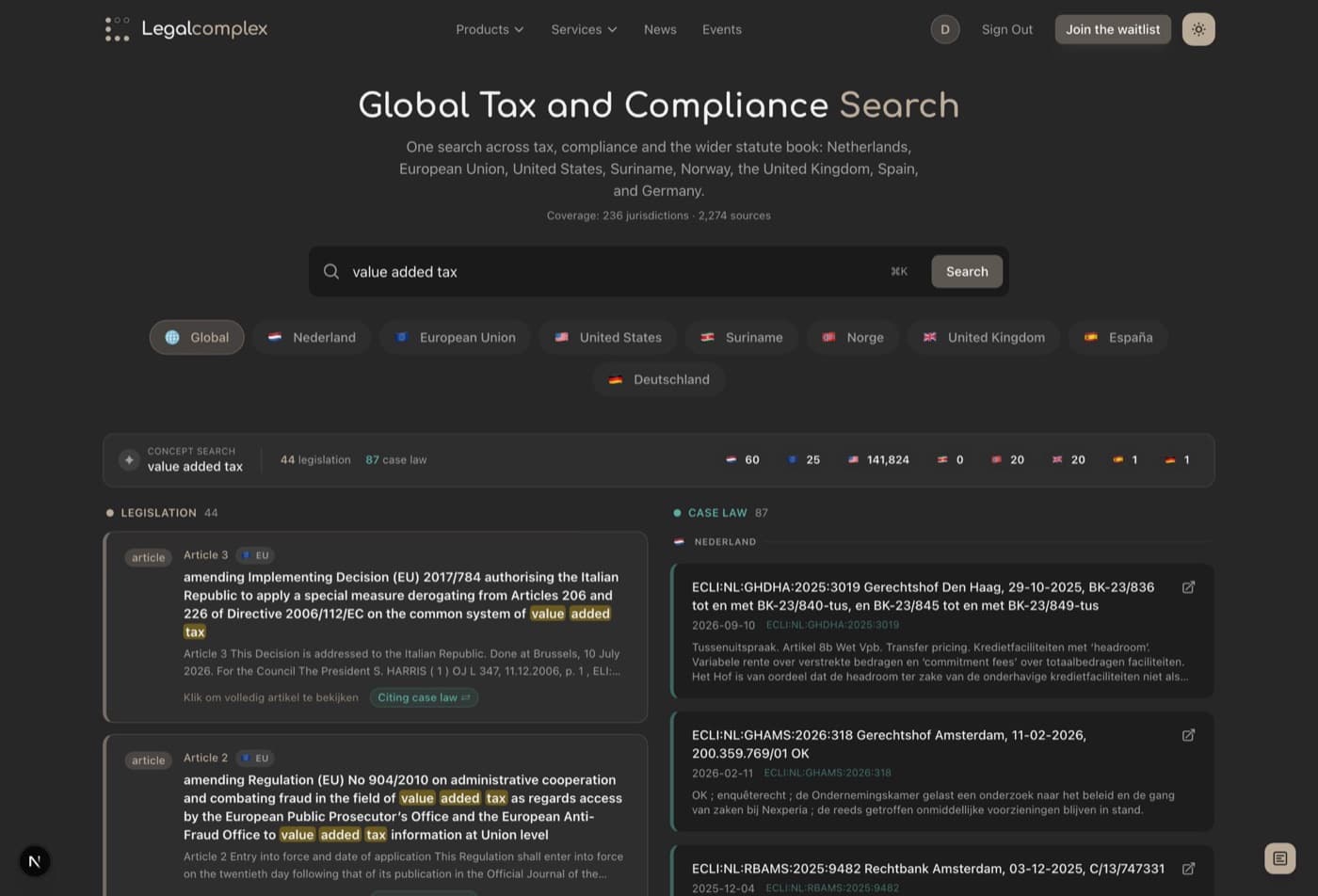
Global Tax & Compliance
Free with an accountOne search across tax, compliance and the wider law, with legislation and case law cross-linked across eight jurisdictions.
So a question that spans countries stops meaning a different national site, and a different search box, for every one of them.
Spark
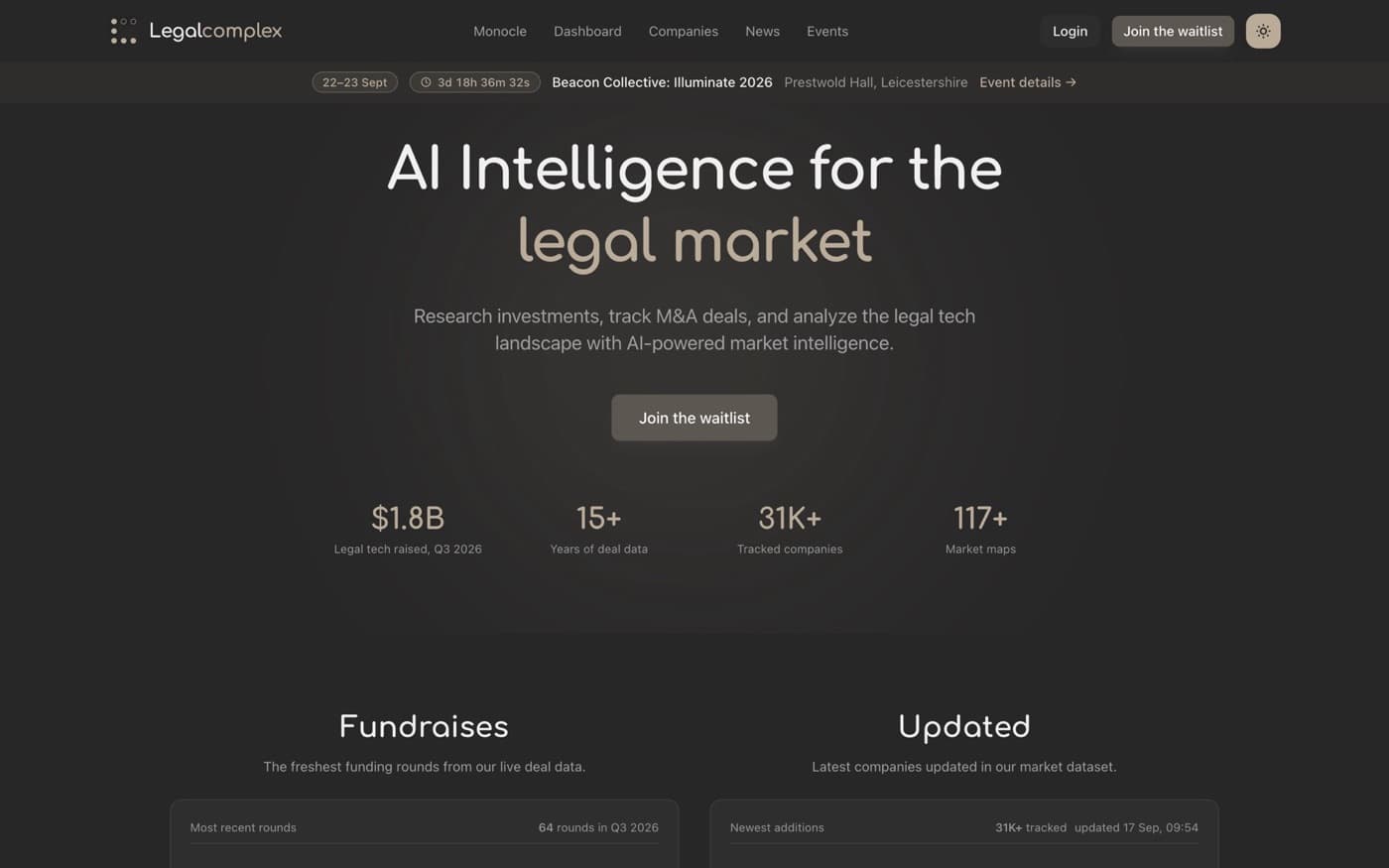
LiveFifteen years of funding rounds and M&A across more than 31,900 tracked companies, kept current by a daily sync.
So founders, investors and strategy teams can see who raised what and who bought whom in one place, instead of assembling it from press releases.
Sabaio Private Intelligence
WaitlistA single secure gateway to every interaction your organisation has with an AI model, running inside your own infrastructure.
So regulated enterprises, law firms and government entities can put AI on real work without a document ever leaving their domain.
Sabaio Contracts
In developmentA contract platform where the contract is the core object, e-sign is the way in, and the identity check behind it is reusable.
So a business is verified once instead of at every counter, and signing stops being the slowest part of the deal. Suriname first.
MCP connector
LiveSix tools over one protocol, putting the Spark market data inside the AI client your team already uses.
So you ask market questions in Claude or Cursor, where the work already happens, instead of keeping another tab open to look them up.
Design and Engineering
A monthly engagement for teams building AI into legal, tax and regulated work. Not an agency and not a generalist consultancy: someone who has built, shipped and verified in this market, working on your product.
Product design
Interfaces for work that has to be checkable. Design canvases, behaviour prototypes that run without a model call, and a component library the shipping code actually uses.
See the deck →Engineering
Architecture, retrieval, AI integration and the plumbing underneath: adapters per jurisdiction, schema migrations against a live writer, deploys that roll back on their own.
See what shipped →Verification
The part most AI work skips. Evals that fail both ways, registries gated on a committed run, and checks designed so that an absent input can never read as a pass. It is also why Monocle retrieves instead of recalling: the S3 benchmark sweeps 2,716 citation statements past a model with no sources attached, and every model tested lands within a couple of points of chance.
See the benchmark results →Market intelligence
Roadmap decisions grounded in the Spark dataset rather than in anecdote: who raised, who bought whom, which segments are actually funded.
See the market dashboard →Portfolio
All of it is live and public, so you can check any claim on this page against the thing itself.
Global Tax & Compliance
One search across tax, compliance and the wider statute book, answering from the official sources rather than from memory.
- 8 jurisdictions, a separate adapter behind each
- Legislation and case law in two lanes that cross-link
- A coverage directory for 236 jurisdictions
- A lane that failed says so, instead of reading as no law
Monocle and Monocle Studio
The design system behind Monocle, and a prototype you can drive end to end without spending a token.
- A design canvas for the omnibox and canvas windows
- A prototype that runs the whole flow with no model call
- Every label read verbatim off the shipping code
- Timings and placements exportable as a spec
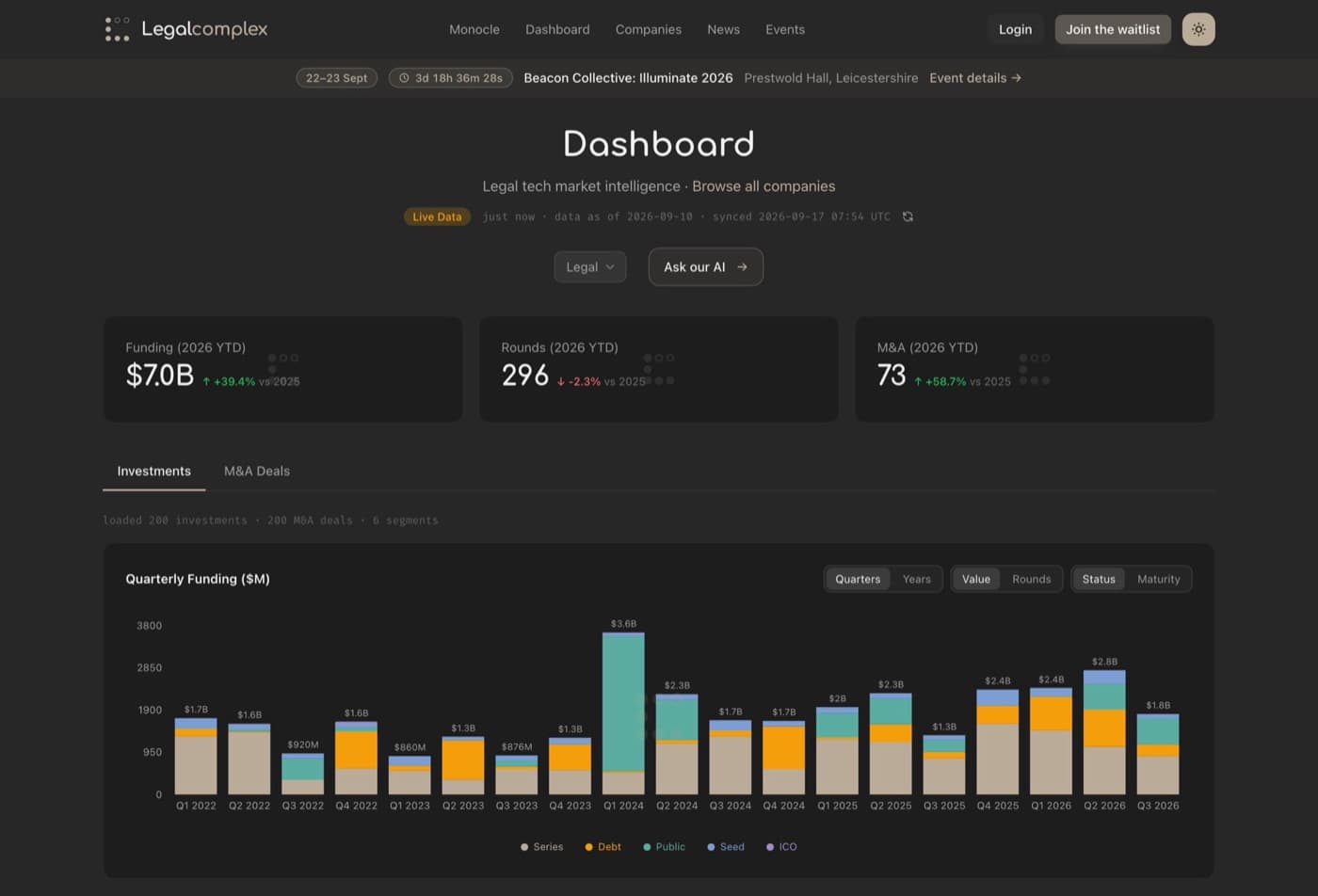
Spark, dataset to dashboard
A curated dataset of who funded, bought and built in legal tech, served as a dashboard anyone can read.
- Fifteen years of funding rounds and M&A
- Kept current by a daily sync from the source dataset
- Quarterly funding, rounds and M&A, split by segment
- Dashboard and directory read one mirror, so they cannot disagree
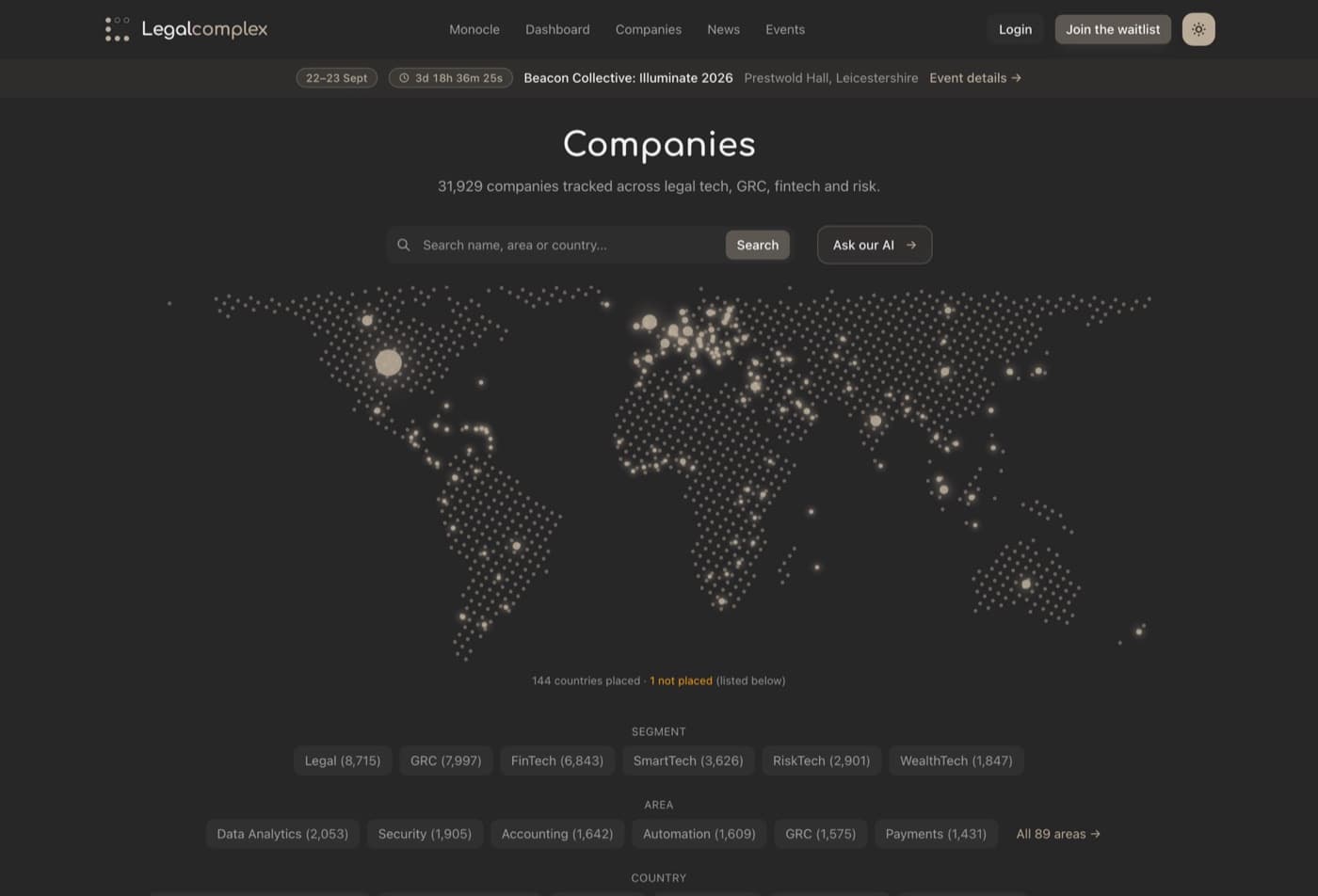
The company directory
Thirty-one thousand company profiles, built to be found and to stay findable.
- More than 31,900 profiles, each on a permanent URL
- Slugs that survive a company being renamed
- An equal-area world map drawn from the data, not a map library
- Carries most of the site's organic search traffic
Legalcomplex.com
The site is its own sample. No third party analytics, CRM, monitoring or services tools connected except for AI services providers.
- Continuous deploys with an automatic rollback
- A health endpoint that reports the commit actually running
- Content in Postgres with an editor over it
- A regression suite that asserts what pages say, not just that they answered
Government
Public-sector engagements where the same discipline applies: definitions that hold, and a structure someone else can still run after we leave.
Ministerie van Defensie
AI governance and infrastructure across the branches of Defence: a NATO-compliant AI platform built on Sabaio-like platform, and the legal evaluation frameworks based on AI Act, the GDPR and NATO's rules.
Hear us on AI governance →Belastingdienst
The Metadata Project: a metadata library of more than 8,000 definitions, a model browser to navigate it, and the guide and governance that keep it usable after delivery.
Read about the project →How we work
Engagements are limited, so each one gets real attention. Scope and rate are agreed per engagement.
- 1ApplyFour fields about what you are building and what you need, then a free 15 minute intro chat. No lengthy intake.
- 2AssessmentA conversation about your stack, roadmap and goals. We agree scope and expectations.
- 3ProposalA one page proposal: tier, rate, duration, and what we work on first.
- 4RetainerTracked hours and a session log through the client portal, so you always know how the hours went.
Ready to talk?
Tell us what you are building and where it is stuck. If it is not a fit we will say so quickly.
Apply for an engagement